The philosophy behind the pipeline

Ideas are not
waiting to be
invented.
They already exist.

Every idea you've ever had — however wild, however premature, however "impossible" — occupies a real space in the universe of potential. The question was never whether the idea exists. The question is whether you've expanded your reality far enough to see it.

Act I

Ideas aren't good.
Ideas aren't bad.
Ideas are potential.

Melvin Kranzberg spent his career arguing that technology is neither good nor bad — nor is it neutral. A fork can nourish or annoy — it depends entirely on who's holding it and what they're trying to do. The fork has no preference. What matters is the hand behind it and the intention that guides it.

The same is true of ideas. An idea for a new material could revolutionize sustainable packaging or accelerate environmental destruction. An idea for a social platform could connect isolated people across the world or become an engine of radicalization. The idea itself is blameless. The person who develops it, defends it, and decides what it becomes — that person carries the weight.

In an age when AI can generate combinations of ideas faster than any human, this argument becomes urgent. The bottleneck has shifted. It is no longer generation that matters. It is judgment. The designer — the maker, the entrepreneur, the creative — is the ethical arbiter of what ideas become real.

The Complete AHA was built on that belief.

"Technology is neither good nor bad; nor is it neutral." — Melvin Kranzberg, First Law of Technology (1986) — and the seed of everything that follows

Act II — The reality bubble

The idea you throw away
changes you anyway.

Every person carries a bubble of what they believe is possible. Most innovation looks impossible — until it doesn't. And once it doesn't, the bubble expands permanently. You can't un-see it.

CURRENT REALITY What you believe is possible ! THE LEAP ARRIVES Crazy. Impossible. Interesting. ! ! ! THE ONTOLOGICAL SNAP EXPANDED REALITY New ideas now have room to exist

Step idea

Comfortable. Stays inside the bubble. Doesn't challenge what you think is possible.

Leap idea

Hits the edge of the bubble. Feels impossible. May never get built. But it lands hard.

The snap

The bubble expands permanently. What couldn't exist before now has room. That's the AHA.

The design science behind it

One idea is a guess.
Many ideas are a strategy.
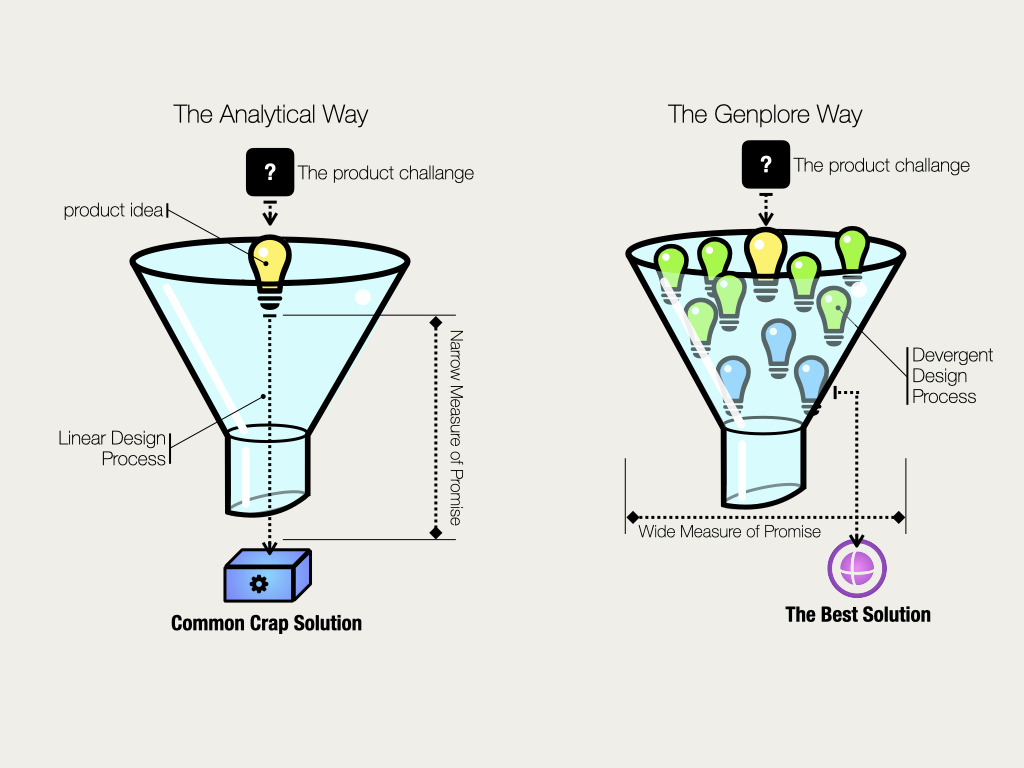
The Analytical Way vs. The Genplore Way — divergent design process diagram by Mike Glaser

The Analytical Way produces one idea through a narrow funnel. The Genplore Way generates many, widens the measure of promise, and finds the best solution — not just the first one.

The linear design process is seductive. You have a problem. You have an idea. You refine it. You ship it. It's efficient. It's also how you end up with the Common Crap Solution — the answer that was always obvious, always safe, and always already done.

The Genplore model — Generate, then Explore — works the way your brain actually works when it's at its best. Generate widely, without judgment. Then explore with full critical attention. The more ideas you put into the funnel, the wider your measure of promise, the better your odds of finding something genuinely novel rather than merely acceptable.

The Complete AHA operationalizes the Genplore model. Feed the AHA generates the brief. Instant AHA blows the concept open across the novelty scale. Rate the AHA scores what you find. It's not inspiration. It's a repeatable process — built on design science, not luck.

On synthesis and originality

"No design can exist in isolation. It is always related, sometimes in very complex ways, to an entire constellation of influencing situations and attitudes. What we call a good design is one which achieves integrity — that is, unity or wholeness — in balanced relation to its environment."

— George Nelson, On Design

What people get wrong about AI's ability to generate ideas is the word "stealing." It isn't stealing. It's synthesis — and designers have been doing it for as long as design has existed.

George Nelson understood this. No design exists in isolation. Every object, every system, every solution is in conversation with everything that came before it. The integrity of a design isn't measured by how untouched its origins are — it's measured by the wholeness it achieves in its moment.

Combinations aren't ideas. A combination is adjacency — two things sitting next to each other. An idea is when a human looks at that combination and decides it means something. That it solves something. That it's worth pursuing. That it has integrity.

The synthesis is table stakes. The judgment is everything. That judgment — ethical, considered, grounded in what the world actually needs — is what The Complete AHA is training you to exercise.

The origin

You can't get paid
waiting for lightning to strike.

Designers don't wait for the AHA moment. They induce it.

The flash of spontaneous creativity — that electric moment when the right idea arrives fully formed — isn't magic. It has a structure. It follows a pattern. And once you understand the science behind it, you can recreate the conditions that produce it on demand.

I'm not saying AHA moments aren't real. They're extraordinary. The problem is you can't schedule them. You can't invoice a client for waiting at your desk hoping the universe delivers. After decades of design practice and teaching, I kept asking the same question: what is actually happening in the brain when that moment fires — and can I reverse-engineer it?

What I found is that spontaneous creativity isn't random. It's the brain doing something very specific: generating widely without judgment, then exploring with full critical attention, then recognizing the pattern that fits. Generate. Explore. Snap.

The Complete AHA is that process made visible, repeatable, and fast. Not a replacement for inspiration. A way to meet it halfway — every time, on purpose.

The original IP

The Kranzberg
Extension.

Kranzberg's First Law (1986)

"Technology is neither good nor bad; nor is it neutral."

The Glaser Extension (2024)

"Ideas are neither good nor bad; nor are they neutral. The designer is the ethical arbiter of what ideas become real."

Kranzberg was talking about technology. I'm extending the argument to ideas — the raw material that technology is made from. Because in an age of AI-generated combinations, the thing that matters isn't how many ideas you can generate. It's how well you can judge them.

The designer's job has always been judgment, not just generation. We just built the process to make that judgment rigorous, repeatable, and grounded in actual design science rather than gut feeling and deadline pressure.

The Complete AHA gives you more ideas — more range, more novelty, more potential. But it was built on the belief that you, the human, are the one who decides which of them deserve to exist in the world. That's not a limitation. That's the point.

Mike Glaser — designer, educator, and founder of The Complete AHA

Mike Glaser — designer, educator, maker

Mike Glaser

Industrial Designer · Educator · Founder, The Complete AHA

I spent decades at Drexel University teaching industrial designers how to think about ideas — not just how to make things. The question I kept returning to wasn't "how do we make better products?" It was "how do we make designers who ask better questions?"

The Complete AHA grew from my MFA thesis research and a lifetime of studio practice. The Step/Jump/Leap novelty framework, the Kranzberg Extension, the Genplore pipeline — these aren't marketing language. They're the distilled output of years of teaching, research, and watching talented people get stopped by the wrong thing.

Not lack of talent. Not lack of tools. Lack of process.

I'm retiring from academic life. This is the next chapter — taking everything I know about how creativity actually works and putting it in the hands of people who need it most. Students at 11pm before a crit. Entrepreneurs with an idea stuck in their head. Designers who know they're capable of more than the safe answer.

The blank page ends here.

Now go make
something.

Three apps. One pipeline. Built on how your brain actually generates ideas — not how people imagine it works. Start anywhere. The pipeline will take you the rest of the way.